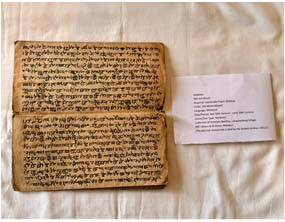
 Manipur has a vast multi-genre corpus of pre-printing press manuscripts written on handmade paper, tree bark, palm leaves, and copper sheets on subjects such as administration, philosophy, arts and culture, history, astrology, medicine, mythology, religion, about hills, rivers, flowers, rocks, cloud formations and others. The corpus also includes several translations from Shan and Indic literatures. Taken together, this manuscript tradition represents a significant and underexamined pre-20th century intellectual heritage, of mainland Southeast Asia and China-Manipur-Tripura-Assam-West Bengal-Bangladesh region, within the global academic landscape.
Thousands of these manuscripts are collectively known as korbek or lairik, and are popularly referred to as puya. Most of them are written in Old Meitei Mayek (the archaic Meitei script) in Classical Meiteirol (also known as Aribalon or Khununglon) as well as in Modern Meiteirol, while many others are written in other Eastern Nagari scripts, such as Bangala and Assamese, in Sanskrit and Old Bengali. There are also manuscripts which contain both Meitei and Burmese scripts.
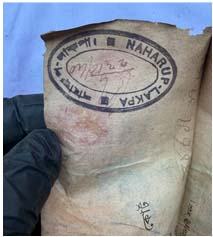 From all this evidence, we know that in the pre-colonial period, Manipur was a multi-script and multilingual society, where diverse forms of knowledge were welcomed and nurtured, and from where they were further transmitted to neighbouring Southeast Asian kingdoms. From our field trips, we have learned that Indic literatures, such as epics like the Ramayana translated into Meiteirol, were written in Old Meitei scripts, whereas non-translated Bangla or Sanskrit literatures were written in Bangala scripts.
Even though the Korbek tradition declined with the coming of Western schools and the printing press, the tradition survived limitedly up to the 1970s or 1980s, even when Meitei traditional handmade paper-making industries were all extinct. Evidence from our fieldwork shows that manuscripts continued to be copied from extremely damaged original manuscripts onto modern papers such as kraft paper cut in the form of folio manuscripts, and even onto the verso of court sermon papers or land documents from the 1940s . We also found that knowledge was disseminated through the practice of copying texts from one custodian to another. A single title was often found in the collections of multiple custodians, written in different hands and on different materials. Thus, we encountered old texts preserved in manuscripts made from modern materials. The earliest forms of manuscripts we encountered were written on agar bark, and manuscripts personally used by kings or royalty were decorated in gold.
The Advanced Research Consortium Library & Archives, Manipur (ARCLA) launched the Korbek Archive in 2025 to create a comprehensive corpus of Meitei manuscripts in both physical and digital formats. The project aims not only at textual preservation but also at offering a way of thinking about history, language, and knowledge from within Manipur’s own intellectual traditions, thereby helping to fill a lacuna in the pre-20th century Southeast Asian literary tradition within the global academic landscape.
Beyond functioning as a mere repository of historical manuscripts, the Korbek Archive functions as a counter-archive and a methodological framework which aims to decolonize epistemology and historiography.
 OUR ARCHIVING METHODOLOGY
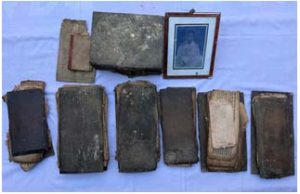
We adopt in situ digitisation methodology to document manuscripts preserved in the private collections of families across Manipur. The approach is shaped by the strong interconnection between manuscript culture, spirituality, and living belief system among the Meitei community.
Manuscripts are understood not merely as carriers of text but as potent cultural and metaphysical entities. Many families believe that these manuscripts exert protective or harmful spiritual effects on the families who preserve them, and that improper handling or reading may lead to misfortune. These beliefs as well as the strong influence of Tantric traditions that spread widely in pre-18th century Manipur necessitate an ethically sensitive approach. Accordingly, all documentation activities are conducted with the respective custodians’ oral consent, respecting local ritual norms, calendrical restrictions, and handling practices.
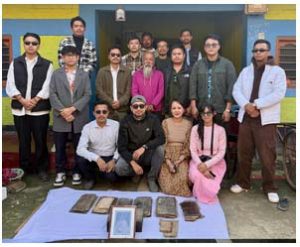 In one case of our fieldwork, digitisation was permitted on auspicious days, determined through Numit-Tha-Yengba tradition of choosing a suitable day. The Meitei community follows both lunar and solar calendars. In this case of our fieldwork, the manuscripts were opened during the waxing phase of the moon (in Meiteirol, Tha-Pankhatlakpa), which is considered ritually appropriate. No documentation was undertaken outside the dates fixed by custodians.
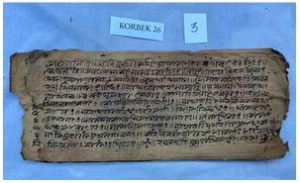 The translocation of manuscripts from their original locations to other places for digitisation and documentation has generally proven ineffective in our approach, although it has been effective in a few cases. This is evidenced by numerous cases we have encountered, as many families consider these manuscripts to be metaphysical entities, among other reasons, making translocations inappropriate.
 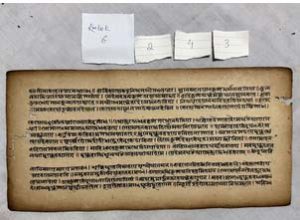 Considering all this, in situ digitisation emerged as the most suitable method through experience. So, manuscripts were photographed at their original locations, eliminating the need for physical translocation, thus reducing cultural and spiritual disruption. All digitisation works were completed within a single day to minimise prolonged exposure and for other practical reasons.
A trained team of volunteers was mobilised to enable rapid and efficient documentation. This collective approach allowed for the digitisation of approximately forty manuscripts and several thousand folios in one day in one case of our fieldwork. Tasks were clearly divided among team members, including handling supervision, image capture, numbering, and metadata verification.
To prevent confusion during post-processing and cataloguing, each manuscript folio was photographed with numerical identifiers. This ensured accurate sequencing, reliable metadata creation, and long-term usability of the digital surrogates.
CATALOGUING
During cataloguing, we assign accession numbers to each surrogate digitised manuscript. Wherever the title of a manuscript can be identified, it is recorded. The material of the manuscript is noted, such as bark, handmade paper, modern paper, and so on. The script is also specified, whether Meitei Mayek, Bengali, or Assamese.
One of the most challenging aspects of cataloguing is assigning years and periods. In most cases, we provide an approximate year range, such as the late 19th – early 20th century. For further classification, palaeographic analysis of letter forms is undertaken. We also plan to record the full set of alphabetic forms for each manuscript for the systematic study of scripts and calligraphy. We also record the genre or text type, such as genealogy, ritual, administration, chronicles, and related categories.
We encounter a vast corpus of manuscripts belonging to the genre of Vaishnavism, which are remnants of the 18th century ‘Reformation’. In addition, we study the physical description of each manuscript, noting whether it is illuminated, rubricated, or illustrated, as well as the ink colours used. We also undertook pigment studies and sent samples for SEM-EDX testing when required. We record the manuscript format, such as folio or folded manuscripts, the binding method (for example, Loose-leaf manuscript bound by a cord through a central perforation, or whether it is covered with wooden boards). Dimensions are carefully measured and documented.
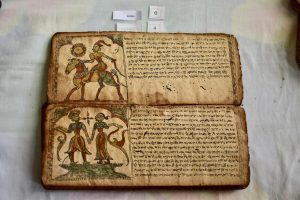 Provenance information is collected through interviews, including details on how the manuscript was preserved, from whom it was passed down, and whether it had any royal courtly association. Rarity notes are also provided, indicating whether parallel copies have been identified or not. Finally, we record the digitisation date and acknowledge the volunteers or researchers involved in the digitisation and cataloguing process.
For researchers wishing to access the manuscripts for scholarly purposes, we provide a full citation sample, including the complete name of the custodian collection. For example:
Langthaballon, Wahengbam Jhulan Collection, Accession No. ARC.KA.0013, Advanced Research Consortium Library & Archives (ARCLA).
We are also in the process of translating the contents of the manuscripts, with around ten scholars currently engaged in this work.
For digital manuscripts donated to us, we make every effort to identify the custodian’s name and catalogue them within our archive, ensuring that a comprehensive digital corpus of the Korbek Archive is maintained. We have also catalogued published transliterations (Bengali and modern Meitei Mayek) and translations (modern Meiteilon and English) of manuscripts. Many such books have been collected and catalogued in our archive, including transliterated works by Pandit Moirangthem Chandra Singh, Oinam Bhogeshwor, Wahengbam Yumjao, Ningthoukhomngjam Khelchandra, Pandit Irom Amubi, Pandit Khumallambam Yaima Singh, Chanam Hemchandra, Konsam Manikchand, and Naoroibam Indramani.
Invitation to scholars
We also invite scholars and researchers to work with our materials and assist in identifying and cataloguing the manuscripts in Meiteilon, Assamese, Bengali, Sanskrit, and Braj in the collective interest of knowledge recovery, decolonisation, and knowledge creation.