Biographical Overview:
Gharib Nawaz, born as Mayamba and popularly known as Pamheiba, was born on 23 December 1690 CE during the reign of his grand-uncle Paikhomba (r. 1666–1698 CE). At the time of his birth, his father Charairongba held the royal office of Yaiskul Lakpa. His mother, Sapam Nungthil Chaibi, died during the childbirth of his younger brother, Loiyumba, before her husband Charairongba ascended the throne. Charairongba had five sons by three consorts.
Charairongba succeeded his uncle Paikhomba in 1698 CE, when Gharib Nawaz was only eight years old. According to Gangumei Kabui, in the absence of a direct line of succession from Paikhomba, palace bloodshed was often inevitable; consequently, Charairongba may have shifted his sons away from the palace to a hill village, a common practice during succession conflicts, and later brought them back once his position as king was consolidated (Kabui 1991, 239), a view earlier anticipated by G. E. Harvey (1925, 317).
Charairongba was the first Meitei king to adopt Hinduism. He built the first Krishna kīyong at present-day Brahmapur Guru Aribam Leikai in May 1707. He died in 1709 CE before he could carry out his planned invasion of Burma and was succeeded in the same year by his eldest son, Gharib Nawaz.
Gharib Nawaz was the founder and ruler of Meckley, with Manipur as its capital, from 1709 to 1748 CE. Meckley was a short-lived empire that emerged from the kingdom of Meitrabak in the eighteenth century. Its military power, political philosophy, and model of kingship significantly influenced mainland Southeast Asia during the eighteenth and nineteenth centuries. Gharib Nawaz’s military campaigns induced the forging of diplomatic relations between the Qing dynasty and the Toungoo dynasty in opposition to him (Kaung 2008, 3-18) and later inspired the founding of the Konbaung dynasty of Burma in the 1750s.
According to historian Michael W. Charney (2011), King Gharib Nawaz significantly shaped the cultural and intellectual landscape of the Burma–Manipur frontier, which later influenced the formation of the Konbaung Empire. Through his policies of religious reform and patronage of scholarship, he created a vibrant intellectual environment along the Burma–Manipur frontier. This encouraged the transmission of Indic, historical, and religious knowledge across the frontier. Collaboration with Manipuri Brahmins and Buddhist monks facilitated this exchange, contributing to the development of monastic practices, literary traditions, and state ideology in the Konbaung period, popularly known as the Sudhamma Reformation in late eighteenth–early nineteenth century Burma. The empire’s formation was thus shaped not only by internal Burmese developments but also by the ideas and reforms emanating from Manipur under Gharib Nawaz’s reformation. This shows how Gharib Nawaz’s legacy shaped the culture and politics of empire-building in mainland Southeast Asia in the eighteenth and nineteenth centuries.
We have two manuscripts from his collection; these may be regarded as the literary remnants of his reformation. Both manuscripts are centred on Rama, a figure widely conceptualised across Southeast Asian kingdoms as a philosophical and political model, particularly in relation to theories of kingship. The literary reforms initiated under Gharib Nawaz, including the translation of the Ramayana into Meiteirol using the Meitei script, appear to have circulated widely across Southeast Asia, extending as far as Thailand. In Cambodia the epic is known as Reamker; in Java as Ramayana Jawa; in Laos as Phra Lak Phra Ram; in Malaysia as Hikayat Seri Rama; in Burma as Yama Zardaw (also rendered as Yamayana); and in Thailand as Ramakien.
Provenance and Donor Information
The manuscripts based on Rama were donated to the ARC Library & Archives by Khangembam Sashikanta in the name of his father, Khangembam Gouro Singh, of Singjamei Wangma Bheigyabati Leikai, Imphal. They are preserved as part of the Khangembam Gouro Singh Collection within the Korbek Archive section.
The colophon of the manuscript entitled Ram Raksha Mantrasya provides information about the provenance of the manuscript. It mentions the copyist and the owner. The text was copied by Ganashyam Sharma and belonged to Maharaja Gharib Nawaz (r.1709-1748 CE).
Following the Anglo-Manipuri War of 1891, Churachand was selected as the new king of Manipur. The site of his new palace was chosen at Guru Lampak in Wangkhei. At that time, the Khangembam family was residing near the Guribam temple complex, the first Hindu temple constructed by King Charairongba in 1707 CE. During his search for Brahmin families, King Churachand requested the Khangembam family to relocate to Bheigyabati Leikai. In 2021, Khangembam Gouro Singh’s son, Khangembam Sashikanta, donated the manuscripts to the ARC Library & Archives.
References
Śrī Rāma Rakṣā Mantrasya
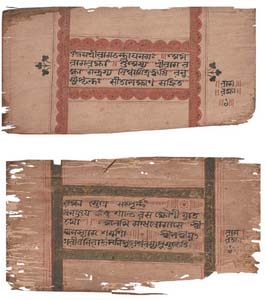 ARC-KA-001
Rama Raksha Mantrasya is an illuminated manuscript with rubrication. The manuscript is made from tree bark and is decorated with gold designs along its borders. It is one of the two documented illuminated manuscripts from Manipur (the other is Ponbilang Sekning in Meitei Mayek, which we have scanned and documented in the Korbek Archive section, ARC.KA.0003). The colophon, which has a gold border on a green ground, provides information about the provenance of the manuscript. It mentions the copyist and the owner. The text was copied by Ganashyam Sharma and belonged to Maharaja Gharib Nawaz (b.1690-d.1752 CE).
Currently, Dr. Yumnam Sapha Wangam Apanthoi M, Assistant Professor, Department of Fine Arts, Manipur University and Wangam Somorjit are working on it with funding from Manipur University. EDX and pigment testing, as well as scanning and translation, have been completed.
Śrī Rām Stavraj Stotra
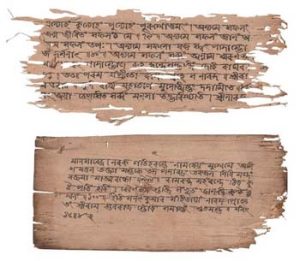 ARC-KA-002
The Sri Ram Stavraj Stotra is a Hindu devotional hymn dedicated to Lord Rama. It is a mantra-based prayer that describes the divine qualities and deeds of Lord Rama and is believed to offer protection and grant wishes to its reciters.
This copy is dated 1648 Samvat (1726 CE). This falls within the heyday of the reign of Maharaja Gharib Nawaz (r. 1709–1748 CE), after his adoption of the Ramanandi Sampradaya on the advice of Sant Dās Gosain of Sylhet.